



































Tne June 4, 1979, a military revolt led by Flight Lieutenant Jerry John Rawlings overthrew the Supreme Military Council II government of General Fred Akuffo in Ghana. The uprising followed a failed coup attempt by Rawlings on May 15, 1979. Public frustration at the time focused on corruption, economic hardship, and lack of accountability among the military elite.
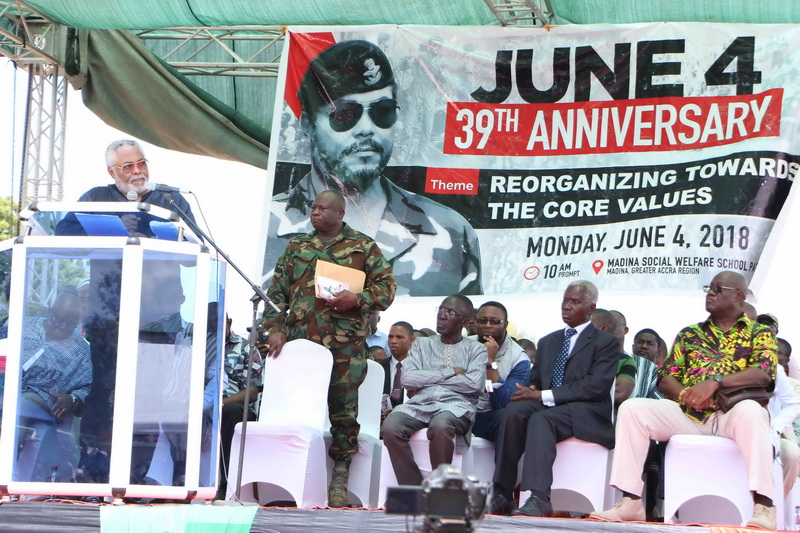
The Armed Forces Revolutionary Council (AFRC) that followed ruled for three months. Its actions included public trials of senior military officers, price controls, and a push for “probity and accountability.” The AFRC handed over power to a civilian government under President Hilla Limann on September 24, 1979, after organizing elections.
June 4 later became a founding narrative for the National Democratic Congress (NDC). When Rawlings returned to power via another coup in December 1981 and later transitioned to constitutional rule, the themes of social justice, anti-corruption, and grassroots mobilization from June 4 remained central to the party’s identity.
Rawlings and the NDC’s Formation.
Jerry John Rawlings died on November 12, 2020. He was the founder of the NDC and served as Ghana’s president from 1993 to 2001 after ruling as head of state from 1981-1993. Under his leadership, the NDC positioned itself as a party of the masses, drawing on the populist energy of June 4 while operating within Ghana’s Fourth Republic constitutional framework.
Since Rawlings’ death, the NDC has had to redefine its internal cohesion and public messaging without its founding figure.
Current NDC Leadership and Challenges.
As of 2025-2026, the NDC is led by former President John Dramani Mahama as its flagbearer, with Johnson Asiedu Nketiah as National Chairman and Fifi Fiavi Kwetey as General Secretary. The party returned to power after the 2024 general elections.
Key challenges for the current leadership include:
- Balancing legacy and renewal: Maintaining the June 4 ideals of accountability and social justice while appealing to younger voters with limited memory of Rawlings’ era.
- Internal unity: Managing factionalism and ensuring continuity between the old guard and emerging leaders within the party structure.
- Governance delivery: Translating campaign promises on economy, jobs, and corruption into measurable outcomes, since the NDC now bears full responsibility for government performance.
The Way Forward.
For the current NDC leadership, the path forward involves using the June 4 uprising as a reference point rather than a blueprint. Three areas stand out:
- Institutionalize accountability: The June 4 call for probity can be channeled into strengthening anti-corruption institutions, asset declaration enforcement, and transparency in public procurement under civilian rule.
- Broaden the party base: Rawlings’ appeal cut across class and region. The current leadership can replicate this by focusing on economic policies that address youth unemployment, cost of living, and access to services, rather than relying solely on historical loyalty.
- Manage succession and ideology: With Rawlings no longer alive, the NDC needs clear mechanisms for leadership development and ideological training so that June 4 principles are passed on through institutions, not just personal memory.
June 4 remains a powerful symbol in Ghanaian politics. For the NDC under its current leadership, the task is to connect that history to present-day governance demands, showing how the spirit of accountability and social justice can operate within a democratic system without Rawlings at the center.
By Ibrahim Hardi Landlord