



































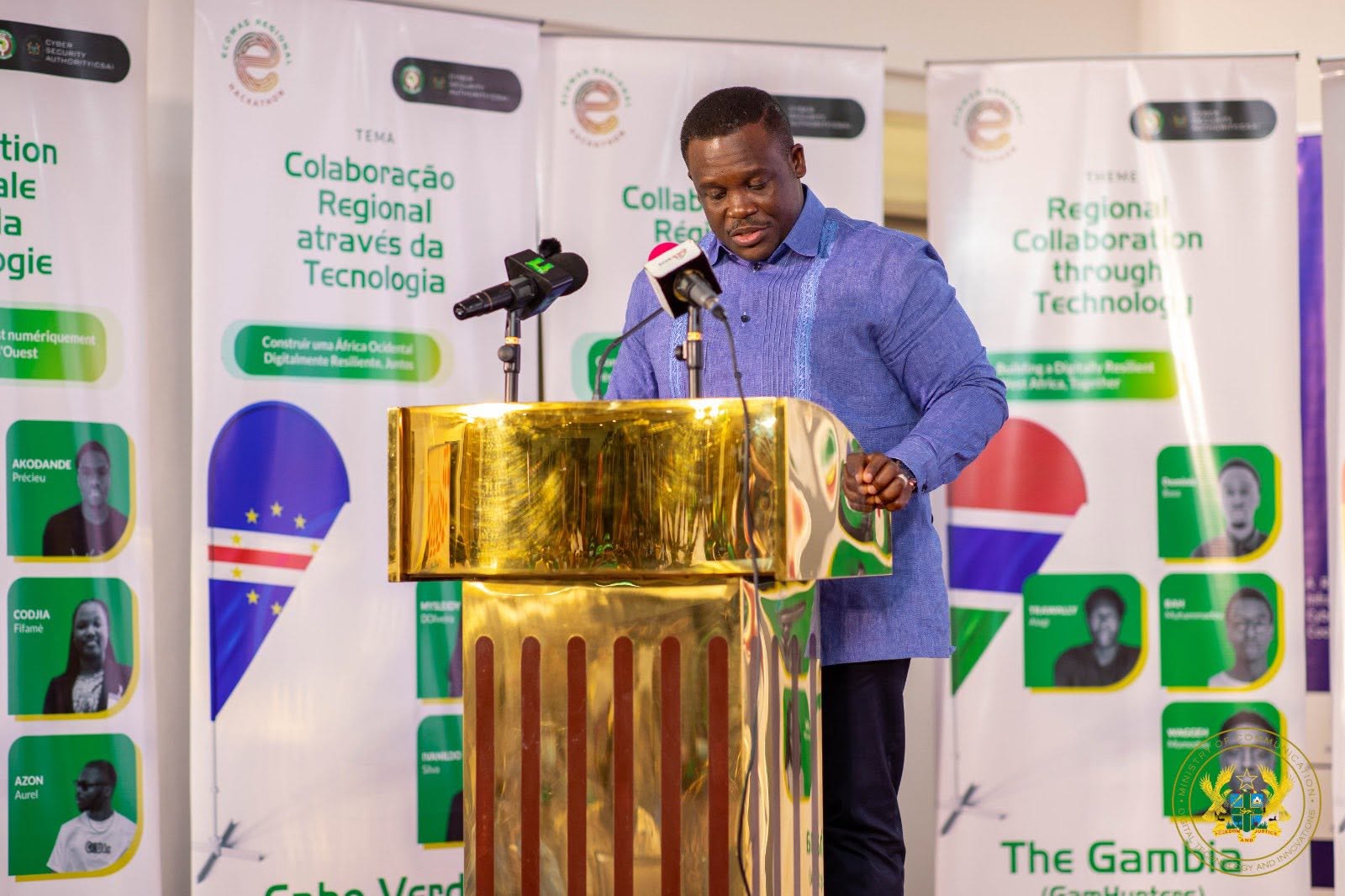
Ghana’s Minister for Communication, Digital Technology and Innovations, Samuel Nartey George, has called on West African developers and cybersecurity professionals to treat digital security as a matter of national sovereignty.
According to him, countries that fail to protect their digital infrastructure risk becoming dependent on foreign vendors and external decision-making.
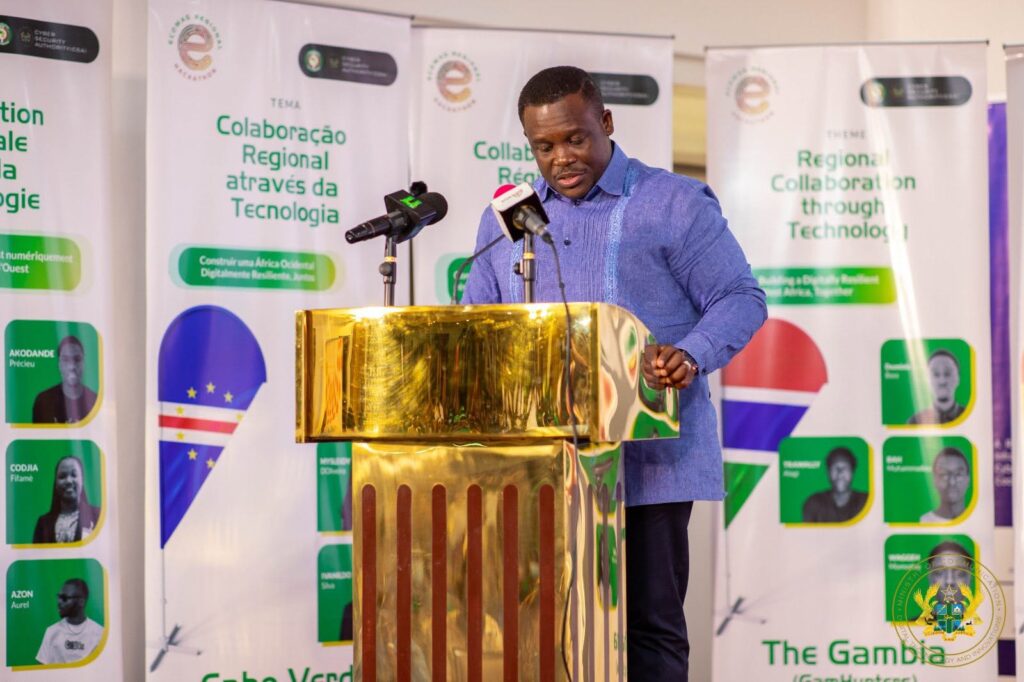
He made the remarks on Tuesday, June 9, 2026, at the opening of the ECOWAS Regional Hackathon held at the Mensvic Grand Hotel in Accra. The 48-hour event brought together developers and cybersecurity experts from across West Africa.
“The future of West Africa’s digital security is being shaped here, by the innovators in this room,” he said.
The Minister warned that despite significant digital progress across the region, growing cyber threats pose serious risks. Citing the Interpol Africa Cyberthreat Assessment Report 2025, he noted that ransomware attacks are locking hospitals out of patient records, while business email compromise scams are causing financial losses to companies and government institutions.
He added that organised criminal networks are running increasingly sophisticated cross-border fraud operations.
“These are not distant, abstract threats,” he stressed. “They are happening in our cities, within our financial systems and institutions right now. The perpetrators are technically capable, well-resourced, and increasingly sophisticated.”
While acknowledging progress made by Ghana’s Cyber Security Authority (CSA) in collaboration with other security agencies to dismantle cybercrime and trafficking-linked scam centres, leading to hundreds of arrests, the Minister expressed concern about the profile of those involved.
“Many of those arrested are young people with real technical ability, but whose skills have been pointed in the wrong direction,” he observed.
He further highlighted the global shortage of more than four million cybersecurity professionals, noting that Africa faces the widest gap. He urged participants to see this as an opportunity rather than a setback.
“This is not a sign of weakness, but of opportunity. The world urgently needs your skills. Our challenge is to build and channel sufficient talent quickly to address real-world problems,” he said.
Referencing warnings by the World Economic Forum, the Minister noted that as artificial intelligence accelerates digital adoption, countries without the capacity to secure their systems risk dependence on foreign expertise.
“That is not a position any sovereign nation wants to be in,” he emphasised.
Touching on Ghana’s response to the talent gap, he highlighted the One Million Coders Programme, a four-year national initiative aimed at equipping one million Ghanaians with skills in coding, cybersecurity, data science, and network support.
“We are not waiting for these professionals to come from elsewhere. We are building them here, and the framework we are developing can serve as a model for our neighbours across the ECOWAS region,” he stated.
He noted that the future of work lies in building and securing digital infrastructure, stressing that demand for such skills continues to grow.
“The jobs exist. The demand is growing. What we need are people ready to step into these roles,” he said.
Addressing participants directly, the Minister encouraged them to treat the hackathon as a real-world exercise.
“I want you to build as if your solution will be deployed in the real world, because it might be,” he said, adding that many impactful African innovations have emerged from similar platforms.
He also urged them to consider the ethical implications of their work.
“The most powerful technology, in the wrong hands or without ethical guardrails, does not create prosperity, it creates risk. What distinguishes great engineers from good ones is not just the ability to build, but whether what they build makes people safer, more empowered, and better off,” he noted.
The Minister further encouraged participants to take advantage of cross-border networking opportunities at the event.
“The connections you build this weekend—with developers from across the region—will outlast this event. Build networks, share knowledge, and create solutions that reflect African realities, not imported templates,” he advised.
He reaffirmed Ghana’s commitment to working with ECOWAS member states and partners to advance the region’s digital future.
“Ghana is fully committed to this future and to working with every ECOWAS member state, every partner, and every one of you to make it a reality,” he concluded.
The ECOWAS Regional Hackathon 2026 is organised by the ECOWAS Commission in partnership with Ghana’s Cyber Security Authority.