






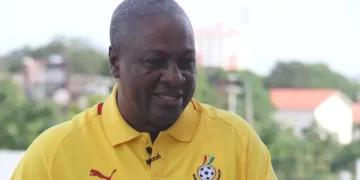







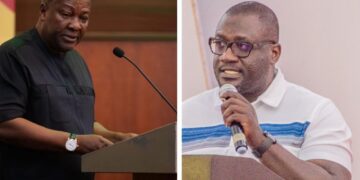



Former Trade Minister and New Patriotic Party (NPP) stalwart, Kwabena Tahir Hammond has cleverly shifted his focus to defending his friend, former Power Minister Dr. Kwabena Donkor, in the US$1 million AKSA bribery scandal, rather than addressing questions about his own role in the controversial power project.
Mr. Hammond, who served as the NPP’s Ranking Member on Parliament’s Select Committee on Mines and Energy when the AKSA power transaction was considered and approved in 2015, has threatened legal action against anyone who links Dr. Donkor to the allegations in the United States prosecution of former Tema Oil Refinery (TOR) Managing Director Asante Kwaku Berko.
On Monday, August 10, 2026, the former trade minister, who now heads the law firm Cavendish Chambers, issued a statement on behalf of Dr. Donkor denying any knowledge of the alleged bribery scheme.
But Mr. Hammond is not the only one withholding information on the matter. Even the Office of the Special Prosecutor (OSP), headed by William Kissi Adjabeng, which confirmed its involvement in the case, said, “It provided investigation and evidentiary assistance to the Federal Bureau of Investigation (FBI) through Ghana’s established mutual legal assistance framework.”
According to the OSP, the United States Department of Justice acknowledged its involvement, describing the assistance as “significant” to the prosecution. However, the OSP did not publicly disclose the nature of the evidence provided or whether the material supplied to the US authorities could be used in potential criminal proceedings against other alleged co-conspirators in Ghanaian courts.
“The involvement of the OSP has been acknowledged by the United States Department of Justice (DoJ) as providing “significant assistance to this prosecution,” according to the OSP statement.”
Berko, whom The Herald is informed stepped on a couple of toes, including those of friends with powerful links within the American political and law enforcement network, faces a maximum sentence of 30 years in prison if convicted in November this year. Some of these friends videotaped him for American investigators.
But Dr Donkor’s statement has raised fresh questions about Mr Hammond’s own involvement in the transaction, particularly his membership of the parliamentary committee that scrutinized and approved the agreement and his alleged presence in Turkey as part of a technical inspection team.
Rather than explaining his own role in the process, including whether he travelled to Istanbul as part of the technical team and who constituted that delegation, Mr. Hammond has focused on distancing Dr. Donkor from the allegations.
The composition of the technical team referred to in his statement was also not disclosed, even though the trip and alleged payments to Ghanaian officials during an inspection visit are part of the evidence presented in the US case.
In a hurriedly issued press release signed by Mr Hammond in his capacity as head of Cavendish Chambers, but bearing no date, the law firm said it was acting on the instructions of Dr Donkor, whose name had become associated with the matter on social media.
“Our client instructs us in very crystal-clear language that he has absolutely no knowledge about the allegations linked to him. He completely and emphatically denies any knowledge of a request or demand for any money, as alleged,” the statement said.
Dr Donkor, through the statement, acknowledged that he was the relevant minister at the time and that the Ministry of Power negotiated with AKSA Enerji Üretim AŞ for the generation of electricity in Ghana during the height of the country’s power crisis.
The statement said a technical team drawn from stakeholders in Ghana’s power sector was sent to Istanbul, Turkey, to inspect equipment intended to generate electricity for Ghana.
But Dr Donkor maintained that he had never met Berko.
“According to our client, at no point in the course of this negotiation did he once set eyes on the said Mr Asante Berko, nor has he since,” the statement said.
It further stated that Dr Donkor had never discussed any personal benefit with Berko or anyone else, never authorized anyone to negotiate such a benefit on his behalf, and had never received money or any personal benefit from Berko or any other person.
The statement also argued that any person who may have demanded money in Dr Donkor’s name did so for his or her own benefit.
Mr Hammond then issued a warning to the media and the public.
“We are instructed to notify the general public accordingly, and to state that any publication or statement of any kind which could be interpreted as contrary to the instructions clearly stated above and which will seek to impugn on the reputation and integrity of our client SHALL result in immediate legal proceedings,” the statement said.
However, Mr Hammond’s intervention has left unanswered questions about his own role in the AKSA transaction.
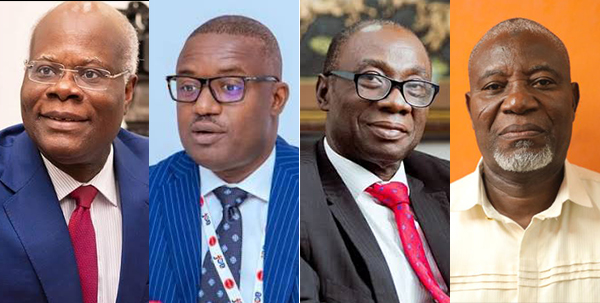
At the time, he was the NPP Member of Parliament for Adansi Asokwa and Ranking Member of the Parliamentary Select Committee on Mines and Energy, chaired by the then NDC MP for Madina, Alhaji Amadu Bukari Sorogho.
The committee was directly involved in the parliamentary consideration of the emergency power agreement between the Government of Ghana and AKSA.
Other members of the committee included the current Ghana Water MD, Adam Mutawakilu, as Vice-Chairman, and Joseph Cudjoe as Deputy Ranking Member.
The US prosecution of Berko alleged that some Ghanaian officials received or were promised bribes in connection with the transaction.
According to evidence presented during the trial, Berko allegedly paid US$46,000 to members of Ghana’s Parliament who ratified the agreement.
Other alleged payments included smaller amounts, with some officials reportedly receiving US$5,000.
The allegations have therefore raised questions about the identity of the parliamentary recipients and the circumstances surrounding the payments.
The US prosecution did not publicly identify every alleged recipient by name.
Mr Hammond’s position on the parliamentary committee at the time makes his own account of the transaction particularly relevant, especially regarding what he knew about the agreement, his participation in its consideration, and whether he travelled to Turkey with the technical delegation.
The renewed controversy follows the conviction of Asante Kwaku Berko in the United States.
On August 6, 2026, a federal jury in Brooklyn, New York, convicted Berko, a dual Ghanaian-American citizen and former Managing Director of TOR, of conspiring to pay and paying more than US$1 million in bribes to multiple Ghanaian officials between 2014 and 2015.
The payments were linked to the development and financing of a power plant in Ghana under an agreement involving the Republic of Ghana, Turkish energy company AKSA Enerji Üretim AŞ, and Goldman Sachs, where Berko was formerly an executive in the Investment Banking Division.
Berko’s sentencing has been scheduled for November 10, 2026. He faces a maximum sentence of 30 years in prison.
US prosecutors presented emails during the trial in which Berko and alleged co-conspirators discussed illicit payments using the phrase “holy rain” as a coded reference to bribe money.
In August 2015, prosecutors said the conspirators discussed US$250,000 in payments to various individuals, including US$46,000 allegedly paid by Berko to members of the Ghanaian Parliament involved in ratifying the AKSA agreement.
The prosecution also alleged that Berko and his co-conspirators used shell companies, sham invoices, nominee account holders, and cash withdrawals to conceal and launder the alleged bribes.
Payments were allegedly channelled through US and foreign bank accounts.
Goldman Sachs eventually withdrew from the transaction after corruption concerns emerged and reported the matter to investigators.
The Herald has intercepted excerpts from a June 2015 memorandum submitted to Parliament by Dr Donkor, then Minister for Power, concerning the emergency power agreement with AKSA.
The memorandum, dated June 15, 2015, was titled: “Emergency Power Agreement with Attached Annexes Between the Government of Ghana (Ministry of Power) and Aksa Enerji Üretim AŞ for the Provision on a Fast-Track Basis, up to 370MW (ISO) Installed Capacity of Power Delivery Services.”
It showed that the Government entered into the agreement against the backdrop of Ghana’s severe power crisis, popularly known as “Dumsor”.
The initial agreement provided for up to 370 megawatts (MW) of installed generation capacity on a fast-track basis.
The memorandum stated that implementing the agreement would increase generation capacity and help address the energy crisis and its impact on the economy, particularly the industrial sector.
“The implementation of the EPA Agreement will enhance generation capacity, which is very critical, particularly in our quest as a nation to end the energy challenge,” Dr Donkor wrote.
The agreement was reviewed by officials from the Ministry of Power, Ministry of Justice and Attorney-General’s Department, the Volta River Authority (VRA), and the Electricity Company of Ghana (ECG).
The Public Utilities Regulatory Commission (PURC) was also consulted, while discussions were ongoing with the Ministry of Finance over the financial terms.
Technical teams from VRA, Ghana Grid Company (GRIDCo), and AKSA had, according to the memorandum, agreed on the technical design and were ready to implement it.
The documents further show that the project had received Executive Approval before Parliament was asked to ratify the agreement.
A June 2, 2015 letter from the then Secretary to the Cabinet, Roger K. Angsomwine, referenced OP/CA20 and informed Dr Donkor that President John Mahama had granted Executive Approval for the agreement between the Government of Ghana, represented by the Ministry of Power, and AKSA.
The letter directed the minister to take the necessary steps to give effect to the approval.
Copies were sent to the Chief of Staff, the Secretary to the President, the Secretary to the Vice-President, and the Senior Policy Adviser/Head of the Policy Delivery Unit.
The memorandum subsequently requested Parliament’s approval, citing the severe economic consequences of the ongoing load-shedding.
“Considering the negative effects of the ongoing load shedding on the economy,” Parliament was respectfully requested to approve the Emergency Power Agreement dated May 12, 2015.
The AKSA project has since grown significantly beyond the initial 370MW arrangement.
The Herald understands that AKSA’s power-generation footprint in Ghana has expanded from the original 370MW to about 1,500MW of installed or contracted capacity.
More recently, the company has received government support for plans for an additional 900MW power project in Takoradi, potentially further expanding its footprint in Ghana’s power sector.
The scale of that expansion is likely to attract renewed scrutiny following Berko’s conviction in the United States and the disclosure of evidence concerning alleged payments to Ghanaian officials during the original AKSA transaction.
The original emergency power agreement was negotiated during one of Ghana’s worst power crises.
But the subsequent US prosecution has now placed the circumstances surrounding that transaction under a different spotlight.
While Dr Donkor has categorically denied any involvement in or knowledge of the alleged bribery, questions remain about the identities of the Ghanaian officials allegedly targeted or paid, the circumstances surrounding the parliamentary ratification of the agreement, and the role played by individuals who participated in the process.
For Mr Hammond, his position as Ranking Member of the Parliament’s Mines and Energy Committee at the time places him among those whose own role in the transaction warrants public clarification.
His legal threat on behalf of Dr Donkor may therefore have shifted attention away from the more pertinent question: what exactly did K.T. Hammond know, and what role did he play in the AKSA transaction?