























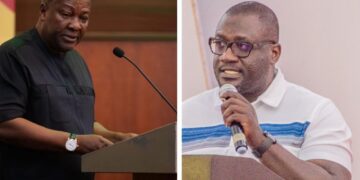



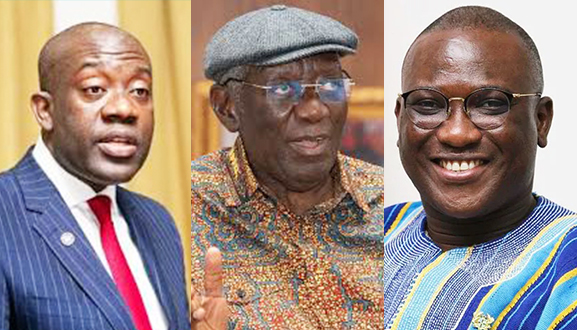
The New Patriotic Party (NPP) has rejected a proposal to extend Ghana’s presidential term from four to five years, with Gushegu Member of Parliament Alhassan Sulemana Tampuli and Ofoase/Ayirebi MP Kojo Oppong Nkrumah leading the party’s opposition to the proposed constitutional reforms.
The NPP insists that the existing four-year presidential mandate should be retained, arguing that it provides an important mechanism for democratic accountability and allows citizens to regularly assess the performance of elected governments before deciding whether to renew or withdraw their mandate.
The party’s position contrasts with a proposal made by former President John Agyekum Kufuor during his final State of the Nation Address in January 2009.
Mr Kufuor, who had completed two four-year terms and was days away from handing over power to President-elect John Evans Atta Mills, urged Parliament to consider extending the presidential term to five years.
“For the president of a struggling, developing nation with weak institutions, perhaps in the case of Ghana, a five-year term, renewable once, will create the needed space for making a better impact,” Mr Kufuor said at the time.
He argued that a longer presidential term would give a newly elected president “reasonable room” to settle into office and make a meaningful impact, particularly where an incumbent was popular but lacked experience upon assuming office.
Interestingly, the National Democratic Congress (NDC), which was preparing to take over the presidency under President-elect John Atta Mills and Vice-President-elect John Dramani Mahama, rejected Mr Kufuor’s proposal at the time.
Seventeen years later, the political positions have effectively changed, with the NPP now opposing a proposal to extend the presidential tenure from four to five years.
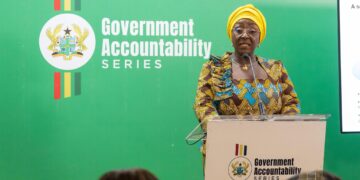
Speaking at a press conference in Accra on Thursday, September 17, 2026, Mr Tampuli said the party had taken a different position from both the government and the Constitution Review Committee (CRC) on the proposed extension.
“The CRC recommended that the presidential term be extended from four to five years. Now, we have taken a different position from the position of the government and the CRC. We do not support the extension, and we support the retention of the existing four years,” he said.
Mr Tampuli said the four-year mandate strengthened democratic accountability by allowing citizens to periodically evaluate the performance of governments and determine whether they deserved another term.
He argued that challenges associated with policy implementation, government transitions and the formation of administrations should be addressed through greater efficiency and timely decision-making rather than by extending the electoral cycle.
“Again, extending the term weakens the principle of regular accountability,” he added.
The CRC, chaired by Professor H. Kwasi Prempeh, recommended extending the presidential term from four to five years as part of a broader package of constitutional reforms.
The committee submitted its final report to President John Dramani Mahama in December 2025.
The government subsequently accepted the proposal in July 2026, alongside a corresponding extension of Parliament’s tenure from four to five years.
The government has argued that the current four-year electoral cycle gives administrations limited time to formulate, implement and properly assess policies.
The NPP, however, maintains that governance challenges should be addressed by improving efficiency rather than extending the electoral cycle.
Oppong Nkrumah challenges constitutional overhaul
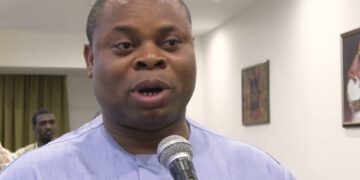
Mr Oppong Nkrumah, who is the NPP Policy Committee Chairman and MP for Ofoase/Ayirebi, used the same press conference to challenge the government’s approach to the proposed constitutional reforms.
He said the NPP was opposed to what it described as an attempt by the government to make sweeping changes to the 1992 Constitution without first establishing a broad-based deliberative process involving key stakeholders.
“The New Patriotic Party therefore rejects this approach being pursued by the NDC government in essentially rewriting the 1992 Constitution,” he said.
According to Mr Oppong Nkrumah, the CRC recommended amendments to 147 of the Constitution’s 299 articles, representing approximately 49 percent of the existing document, alongside 59 new provisions.
He argued that the scale of the proposed changes went beyond what could ordinarily be regarded as an amendment.
“Amendment of 147 of 299 articles, together with 59 new provisions, that is, 206 reaching into the executive, the legislature, independent constitutional bodies, and local government, is not just an adjustment to some provisions of the Constitution; they amount to the overhaul of the Constitution and, in substance, the enactment of a new one,” he said.
Mr Oppong Nkrumah also raised concerns about what he described as significant disagreements between the government and the CRC over the recommendations.
He claimed that the government had substituted its own position for about 100 of the 147 recommendations made by the independent committee established by the President.
He further claimed that the government had declared the consultation process closed and instructed its implementation committee to draft proposals without further negotiations, with November 2026 set as the deadline for the first amendment.
The NPP Policy Committee Chairman said the party was concerned that there was currently no platform for political parties, organised labour, professional bodies and other identifiable groups to deliberate on the issues in dispute.
NPP calls for Constituent or Consultative Assembly
Mr Oppong Nkrumah said Ghana’s previous constitutional processes in 1969, 1979 and 1992 involved expert work followed by deliberation through broad and representative assemblies before the proposals were given the force of law.
“First, the work of an expert deliberated and settled upon by a broad and representative assembly and only then given the force of law. This was done in 1969, in 1979, and in 1992 and that is what we are calling on the government to respect now,” he said.
The NPP is consequently calling on the government to introduce a Constituent or Consultative Assembly Bill in Parliament to establish a formal deliberative assembly for the constitutional reform exercise.
Mr Oppong Nkrumah said the proposed mechanism would also provide a platform for resolving what he described as more than 100 areas of disagreement between the government and the CRC.
NPP rejects expansion of Parliament
The party also rejected a recommendation to increase Ghana’s parliamentary seats from the current 276 to a maximum of 300.
Under the proposal, the additional 24 seats would be allocated through proportional representation, including women, the youth and persons with disabilities.
The NPP said there was insufficient evidence that expanding the size of Parliament would improve the effectiveness of the legislature or lead to better representation and governance.
Mr Tampuli said the party disagreed with both the CRC and the government on the proposed expansion, arguing that Ghana’s existing parliamentary representation was already substantial in relation to the country’s population.
He said any increase in the number of lawmakers should be supported by clear evidence that it would address existing challenges within Parliament.
“Both the CRC and the government recommended an expanded legislature, to have a ceiling of 300 legislators. The additional 24 legislators will be based on proportional representation, including women, the youth, and also persons with disabilities. We disagree with both positions,” he said.
“We think that Ghana’s current parliamentary representation is already substantial in relation to the population. There is no demonstrated evidence that increasing the number of parliamentary seats will necessarily make Parliament more effective,” he added.
The NPP’s objections form part of its broader reservations about the proposed constitutional reforms, including changes to the tenure of the presidency and Parliament, the composition of the legislature and the process for amending the 1992 Constitution.
The party maintains that any fundamental changes to Ghana’s constitutional framework should be subjected to broad consultation and deliberation before being given legal effect.