
















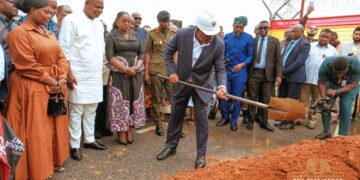


















Deputy Chief of Staff in charge of Operations and Chairman of the National Flood Mitigation Taskforce, Stan Dogbe, has clarified that Sunday morning’s exercise at the Laboma enclave was not a blanket demolition of businesses in the area.

According to him, the exercise targeted specifically marked structures that had to be removed to allow for the dredging of silted areas within the Kpeshie Lagoon’s water-retention basin.
“Sunday morning’s exercise by the Post Flood Mitigation Task Force and the REGSEC was not a demolition of Laboma,” Mr Dogbe said in a Facebook post.
He explained that the basin, which historically held water flowing downstream into the sea, has been affected by the destruction of vegetation and the filling of portions of the area with solid materials, including boulders, for construction.
Mr Dogbe said these developments have affected the flow of water from upstream towards the sea and reduced the basin’s capacity to retain floodwaters.
He also said the owners of the structures targeted in Sunday’s exercise had been alerted by the Greater Accra Regional Security Council (REGSEC) more than a month earlier.
“It is these structures that the owners were alerted more than a month ago, by the REGSEC, that were pulled down on Sunday morning. Other structures and businesses have not been touched because that is not within the work scope and mandate of the Task Force,” he said.
The exercise followed a directive issued by REGSEC, after an inspection of the Laboma Beach enclave, ordering occupants within what used to be a protected lagoon buffer zone to vacate within 21 days.
Mr Dogbe added that the demolition team also removed a newly constructed wall along the Labadi-Teshie road, which he said was blocking an area where vegetation had been destroyed and filling with solid materials was ongoing.
The Kpeshie Lagoon has been identified as a critical intervention point under the post-flood mitigation programme, with years of illegal reclamation, sand filling and uncontrolled development blamed for reducing its natural capacity to retain floodwaters.
Accra-Kumasi corridor and provide a modern alternative to the existing route.