





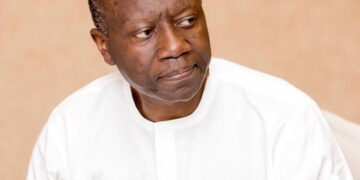


























The detention of former Finance Minister Ken Ofori-Atta by United States Immigration and Customs Enforcement (ICE), has deepened into a multi-layered controversy, exposing sharp contradictions between his legal team and Ghana’s diplomatic mission in Washington, while fuelling wider political and public disquiet at home.
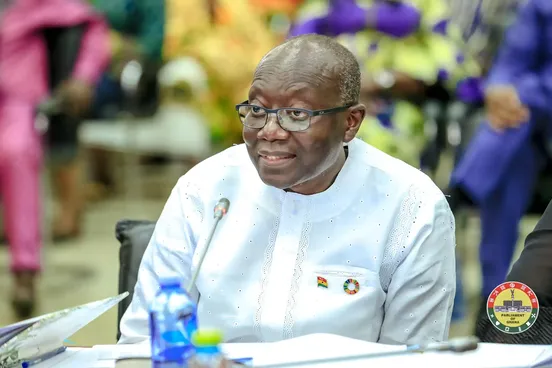
At the centre of the latest dispute is the issue of Mr Ofori-Atta’s medical condition at the time of his arrest. Frank Davies, a member of the former minister’s legal team, has openly challenged claims by Ghana’s Ambassador to the United States, Victor Smith, that ICE confirmed Mr Ofori-Atta was “medically fit for detention”.
Mr Davies described such statements as unnecessary, misleading, and intended to distort the real issue, while questioning the Mahama government’s fixation on Mr Ofori-Atta compared to Sedinam Tamakloe-Attionu, former Chief Executive Officer (CEO) of the Microfinance and Small Loans Centre (MASLOC).
“At no particular point in time have we said that Ken Ofori-Atta was picked up by ICE from a medical facility or on a hospital bed,” he said yesterday.
“So this business of him being medically fit is unnecessary at this point to be banging these words about.”
The lawyer questioned why public officials appeared intent on rebutting claims that had never been made, insisting that the debate had been deliberately shifted away from Mr Ofori-Atta’s post-surgical recovery and medical clearance.
“Who said that he was in the ICU before he was picked up by ICE?” Mr Davies asked. “He was picked up in his home or wherever they picked him up.”
Despite acknowledging that the former finance minister had undergone surgery, Mr Davies stressed that the concern raised by the legal team relates to his recuperation period and continued medical supervision, not the location of his arrest.
“He has gone for surgery, which we all know,” he said. “All we are saying is that he is recuperating and that he is in consultation with his medical team, and they will have to give him the all-clear to come.”
However, Ambassador Smith has maintained that ICE followed due process. In media interviews, he disclosed that ICE arranged for medical personnel to assess Mr Ofori-Atta shortly after his arrest on January 6, 2026, in Washington, DC, and concluded that he was fit to be held in a detention centre.
“Yes, the ICE people confirmed that he was all right,” Mr Smith said. “He was on medication, but he wasn’t seeing any doctor at the time, so he could be put in the detention centre.”
The Ambassador further revealed that the arrest involved not only ICE but also the Federal Bureau of Investigation (FBI), raising fresh questions about the true scope of the case.
“When the FBI gets involved, then there must be some criminality or an Interpol request triggering a red alert,” Mr Smith said, suggesting the matter may go beyond routine immigration enforcement.
While no formal criminal charges have been announced in the United States, the disclosure has intensified public speculation, particularly in Ghana, where Mr Ofori-Atta is already facing corruption and corruption-related charges linked to the Strategic Mobilisation Limited (SML) scandal.
Mr Davies, meanwhile, has accused the Ghanaian authorities of selective justice, arguing that the state’s apparent urgency in pursuing Mr Ofori-Atta contrasts sharply with its failure to secure the return of Mrs Tamakloe-Attionu, a convicted fugitive.
“Sedinam Tamakloe-Attionu has been convicted by a court of competent jurisdiction of corruption and corruptible tendencies,” he said. “She is a criminal fugitive in the United States.”
According to Mr Davies, a government that claims to be committed to fighting corruption must demonstrate fairness and consistency.
“They should be able to bring Attionu back to Ghana, and then they can deal with Ken Ofori-Atta,” he said, warning that what he described as double standards, hypocrisy and intellectual dishonesty could fatally undermine public confidence in the justice system.
Beyond the legal sparring, political pressure on Mr Ofori-Atta continues to mount.
Former Subin MP Eugene Boakye Antwi has publicly criticised the former finance minister’s prolonged absence from Ghana, describing it as politically damaging to the New Patriotic Party (NPP).
“If Ken Ofori-Atta is innocent, he should come back and face the law,” Mr Boakye Antwi said, arguing that the situation has reinforced public perceptions of corruption within the party.
Mr Boakye Antwi, criticised former Finance Minister over his continued absence from the country despite an ongoing state investigation against him.
According to Boakye Antwi, the former minister’s failure to return and respond to the allegations is damaging the image of the NPP and creating the impression among the general public that members of the party are corrupt.
Speaking in an interview on Oyerepa TV on January 12, 2026, the former MP said that if Ken Ofori-Atta is truly innocent, he should return to Ghana and face the law.
“Have you ever seen a political party leave government and its finance minister cannot be found? It has been one year since Kissi Agyebeng started mentioning Ken Ofori-Atta’s name. Do you know the damage that has caused the party? They have implanted in the minds of Ghanaians that the NPP are thieves,” he said.
Boakye Antwi further stressed that public funds belong to the people of Ghana and that government officials are merely custodians of those resources.
“All the taxes we collect go into the Consolidated Fund, and those monies belong to Ghanaians. We are only custodians of the nation’s resources. So, if you are accused by the state of financial malpractice, why are you running away? Come back and explain yourself,” he added.
Meanwhile, Ambassador Smith has sought to shut down speculation about Mr Ofori-Atta’s nationality, confirming that ICE is in possession of three Ghanaian biometric passports belonging to him.
“So clearly, that is a Ghanaian,” he said, adding that once nationality is established, the only remaining question before the immigration judge is Mr Ofori-Atta’s immigration status.
According to the Ambassador, if the judge finds no legal basis for the former minister to remain in the United States, he could be placed on the next available flight to Ghana.
As the case heads towards a decisive immigration hearing on 20 January 2026, possibly conducted virtually, it has become more than a question of visas and medical fitness. It now stands as a test of credibility for Ghana’s justice system, its diplomatic messaging, and the political class’s commitment to equal accountability under the law.